Showing posts with label Sweden. Show all posts

Wednesday, 17 April 2013

Swedish Royal Family


 Sweden is my fave country in the planet Earth . This postcard is from our swap with Anders ,who was so kind that he sent me huge pile of swedish postcards.Tack ,Anders :)

 On this postacard you can see the Swedish Royal Family , since 1818 consists of a number of persons in the Swedish Royal House of Bernadotte, closely related to the King of Sweden. They are entitled to royal titles and style (manner of address), and some perform official engagements and ceremonial duties of state. The extended family of the King consists of other close relatives who are not royal.
Prior to 1818, the Swedish Royal Family was the House of Holstein-Gottorp, a cadet branch of the Oldenburg dynasty which ruled Sweden from 1457 to 1521 (then intermittently) and from 1751 until 1818. That dynasty's last legal pretender to the Swedish throne was Prince Gustav of Wasa (1799-1877) whose only son Louis predeceased him in infancy in 1832.

 Current members:
According to the Swedish Government, the Royal Family includes the following:
  • The monarch and his spouse:
    • His Majesty King Carl XVI Gustaf (since 15 September 1973), born on 30 April 1946.
    • Her Majesty Queen Silvia (since 19 June 1976), born on 23 December 1943.
  • The King's children:
    • HRH Crown Princess Victoria, Duchess of Västergötland, born on 14 July 1977.
    • HRH Prince Carl Philip, Duke of Värmland, born on 13 May 1979.
    • HRH Princess Madeleine, Duchess of Hälsingland and Gästrikland, born on 10 June 1982.
  • The King's grandchildren:
    • HRH Princess Estelle, Duchess of Östergötland, born on 23 February 2012, daughter of Crown Princess Victoria and Prince Daniel.
  • The King's son-in-law (husband of the Crown Princess):
    • HRH Prince Daniel, Duke of Västergötland, born on 15 September 1973.
  • The King's sister:
    • HRH Princess Birgitta, Princess of Hohenzollern, born on 19 January 1937.

    Royal Palace in Stockholm


    Swedish flag

Friday, 7 December 2012

Oskarshamn

  Oskarshamn is a costal city in Sweden and has 17 528 inhabitants(2010)

The location of Oskarshamn was known as Döderhultsvik since the medieval age. In 1645, the city of Kalmar, to the south, made a request to the Royal Government on holding commerce in the bay there, which was granted, giving it merchancy rights as a köping. There followed 200 years of merchancies in the town, during which it was governed and dependent on Kalmar; while the surrounding towns and municipalities made frequent requests to grant it a charter, consequently turned down each of the attempts made in the years: 1786, 1798, 1800, 1815, 1818, 1823, 1825, 1830 and 1838. In 1843 it got some independence, with a local council, but the council itself was occupied by citizens of Kalmar. In 1854, the King Oscar I of Sweden promised to grant it a charter as soon as it had fulfilled certain demands, including building a prison and a council hall, among other things. When they had accomplished the feats, the charter was granted, and the city became one of the Cities of Sweden starting 1856, on May 1. This status has today no legal significance, but Oskarshamn is now the seat of the much larger Oskarshamn Municipality, without being a political entity of its own.

The Royal Warship Vasa

Vasa is one of the coolest things I have ever seen(beside a submarine :D,but this is a diffrent story  )

Vasa museum in Stockholm,Sweden is one of the coolest museums in Swede.It is a must when visiting Stockholm.

Vasa is a Swedish warship built 1626-1628. The ship foundered and sank after sailing less than a nautical mile (ca 2 km) into its maiden voyage on 10 August 1628. It fell into obscurity after most of its valuable bronze cannon were salvaged in the 17th century. After it was located again in the late 1950s in a busy shipping lane just outside the Stockholm harbor, it was salvaged with a largely intact hull in 1961. It was housed in a temporary museum called Wasavarvet ("The Wasa Shipyard") until 1987 and then moved to the Vasa Museum in Stockholm. The ship is one of Sweden's most popular tourist attractions and has been seen by over 29 million visitors since 1961.
Vasa was built top-heavy and had insufficient ballast. Despite an obvious lack of stability in port, it was allowed to set sail and foundered only a few minutes after it first encountered a wind stronger than a breeze. The impulsive move to set sail was the result of a combination of factors: Swedish king Gustavou Adolphus, who was leading the army on the continent on the date of its maiden voyage, was impatient to see it join the Baltic fleet in the Thirty Years´ War; at the same time, the king's subordinates lacked the political courage to discuss the ship's structural problems frankly or to have the maiden voyage postponed. An inquiry was organized by the Swedish privy concil to find personal responsibility for the disaster, but in the end no one was punished for the fiasco.
During the 1961 recovery, thousands of artifacts and the remains of at least 15 people were found in and around the hull of the Vasa by marine archaeologists. Among the many items found were clothing, weapons, cannon, tools, coins, cutlery, food, drink and six of the ten sails. The artifacts and the ship itself have provided historians with invaluable insight into details of naval warfare, shipbuilding techniques and everyday life in early 17th-century Sweden. Vasa was intended to express the expansionist aspiratsions of Sweden and to glorify king Gustavus Adolphus. No expense was spared in decorating and equipping the Vasa, which was also one of the largest and most heavily armed warships of its time.

And everyone who likes "Pirates of Carribean " knows The Flying Dutchman ,I guess. The look of the fictional ship was inspired by the seventeenth century Dutch "fluyt" vessels and the Vasa.

Sunday, 17 June 2012

Kristinehamn, Sweden

Kristinehamn is situated by the shores of lake Vänern. To be precise, it is situated where the small rivers Varnan and Löt drain into the lake.
It has a harbour and is a railroad and road transportation center.
Nearby towns include Karlskoga and Karlstad and is located exactly in the middle of Oslo , Stockholm and Gothenburg with 250 km to each of them.

  By the shores of lake Vänern stands this 15 meter high Pablo Picasso  statue since 1965. The statue was concipated from Picasso, but built and inaugurated without him visiting the construction site. Picasso never visited Kristinehamn. Its 15 meters make it the tallest Picasso Sculpture in the world.You can see the statue on card aslo.

Öland , Swden

It has been almost a year  without new posts :S .

It is time to show a new card.This time it is from my Sweden cards.This card shows Öland. Öland is the second largest Swedish island.and the smallest of the traditional provinces of Sweden. Öland has an area of 1,342 km² and is located in the Baltic Sea just off the coast of Småland. The island has 25,000 inhabitants, but during Swedish Midsummer it is visited by up to 500,000 people.It is separated from the mainland by the Kalmar stait and connected to it by the 6 km Öland bridge, which opened in 1972.

Sunday, 19 December 2010

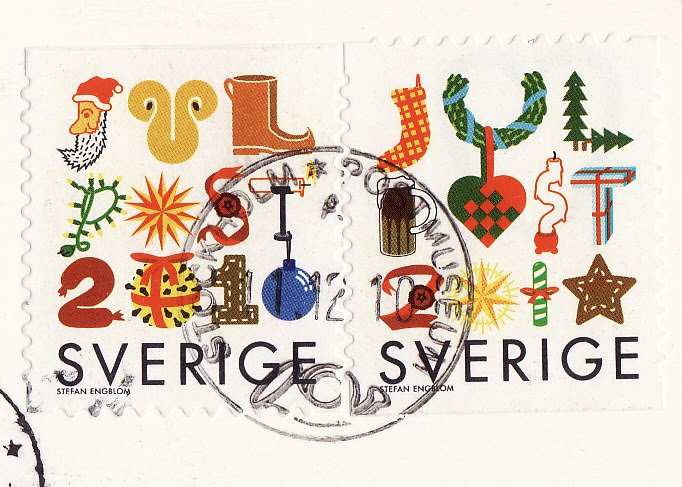
Sverige Julkort


Beautiful swedish christmascard from SusaTiina.New perfect card to my Sweden colllection.
Tack,Susa:)

Wednesday, 6 January 2010

Emil i Lönneberga


I love Emil i Lönneberga book:)All Astrid Lindgren´s books are great.


Emil Svensson lives with his family on a farm called Katthult. His age ranges about five and eight years old in the books. He has got fair hair and blue eyes and looks like an angel, but is not, as he also has a prodigious knack for getting into trouble. Contrary to what most people around him think, Emil is not malicious, but does not think about the consequences of his actions. He even states at one point that "you don't make up pranks, they just happen".The pranks come from kindly actions gone wrong, childish games, curiosity, bad luck and simple thoughtlessness. For example, he gives away food meant for visiting relatives to the poor because in his view they need it more. Other pranks involve his locking his father in the outhouse thoughtlessly when he was locking other doors, hoisting his willing little sister up a flag pole to see how far you could see from there (not realising how dangerous it is) or making everyone believe they are infected with typhus when playing a pretend-game with his sister. Most of the time Emil plays a prank, he escapes his choleric father's wrath by running away quickly and locking himself in a tool shed. Since the door can also be locked from the outside, his father responds by locking him in there for a while as punishment. Emil is usually embarrassed by what he has done, but it is not a severe punishment for Emil, who likes sitting in the shed and takes to carving a wooden figure during each of his stays. He eventually accumulates 369 of them, except for the one his mother buries because she claims it looks too much like the rural dean. Emil is extremely intelligent and creative, and tends to think in very unconventional ways, which the adults are more likely to misunderstand than to understand.

Emil is also very resourceful. He is very handy with any type of farm animal, especially horses. He is also brave, he saves farmhand Alfred's life when he had blood poisoning. Alfred was near death and the road to the doctor was covered in snow from a severe blizzard. Emil defied the bad weather and traveled by horse and sleigh to the doctor, thus saving Alfred's life.

In the end, Emil is said to have grown up into a responsible and resourceful man, becoming eventually the Chairman of the Municipality Council.

Emil's parents are Anton and Alma Svensson; Ida, his little sister, is a very well-behaved child, unlike him. She has tried to pull pranks like her brother since she wanted to go to the shed, which she thinks is cozy, but she failed. His father, in particular, is often angry with his son, though it has been seen many times he still likes him a lot when he does not make pranks. His mother, however, adores her boy and tends to say, "Emil is a nice little boy, and we love him just the way he is." She also writes down every bad thing Emil does, in a blue book, although, that blue book expands to several blue books. Alfred is the family's farmhand, and Lina is their maid. Alfred, who is very fond of children, is Emil's best friend, whereas Lina dislikes the boy. She is in love with Alfred and pesters him with her wish to marry him, a subject which Alfred tends to avoid.

Emil's father is portrayed as a stereotypical inhabitant of Småland - for example, he does not like spending money, to the point of being cheap. Church is very important, and the pastor is a regular visitor. Alcohol and swearing are strictly forbidden in the Svenssons' house. The books give a vivid impression of Swedish farmers' daily life in the beginning of the 20th century.


Astrid Lindgren

Astrid Anna Emilia Lindgren Ericsson, 14 November 1907 – 28 January 2002) was a Swedish author and screenwriter who is the world's 25th most translated author and has sold roughly 145 million copies worldwide. She is best known for the Pippi Longstocking, Karlsson-on-the-Roof and the Six Bullerby Children book series.

Astrid Lindgren grew up in Näs, near Vimmerby, Småland, and many of her books are based on her family and childhood memories. However, Pippi Longstocking, one of her most famous characters, was invented to please her daughter Karin, who was, at the time, ill and bed-ridden.

Lindgren was the daughter of Samuel August Ericsson and Hanna Johnsson. She had two sisters. Her brother, Gunnar Ericsson, was a member of the Swedish parliament. Upon finishing school, Lindgren took a job with the a local newspaper in Vimmerby. When she became pregnant with the chief editor's child in 1926, he proposed marriage. She demurred and moved to Stockholm, learning to become a typist and stenographer. In due time she gave birth to her son Lars in Copenhagen and left him in the care of a foster family.

Although poorly paid, she saved whatever she could and travelled as often as possible to Copenhagen to be with Lars, often just over a weekend, spending most of her time on the train back and forth. Eventually, she managed to bring Lars home, leaving him in the care of her parents until she could afford to raise him in Stockholm. In 1931 she married her boss, Sture Lindgren (1898-1952). Three years later, in 1934, Lindgren gave birth to her second child, Karin, who became a translator. The family moved in 1941 to an apartment on the Dalagatan, with a view over Vasaparken, where Astrid lived until her death.

Astrid Lindgren died in 2002, at the age of 94.